Thursday, 29 December 2011

X-Men: First Class

***
Who’d a thunk the producer of Lock Stock… and Snatch would wind up being such a competent director. The producer-turned-director is a rare bird. The only ones that spring to mind are Joseph L Mankiewicz and Alan J Pakula. But Matthew Vaughn has done it again – he has made yet another exceedingly entertaining film. He’s also breathed new life into a flagging franchise and, although it didn’t entirely set the box office a light, it’s not done too shabbily.

This prequel sees Professor Charles Xavier (James McAvoy) with legs and hair, just starting out as leader of the disparate band of superheroes. With the action skilfully set against a Cold War/Cuban Missile Crisis backdrop, he forges an alliance with the CIA. This is to track down and then train other mutants, teaching them to harness their special powers. All the while, holocaust survivor Erik Lehnsherr (Michael Fassbender) seeks revenge for atrocities committed by all-round bad guy, Sebastian Shaw (Kevin Bacon).

The film sees some delicious early sixties period detail making it so much more interesting than its predecessors. Henry Jackman embraces the age delivering a sixties-tinged score which, at times, can only be described as ‘groovy’. The film-makers must be commended on some inspired casting choices; the likeable McAvoy is straighter than an arrow as philanthropist Professor X, Fassbender gets sympathy for his devil-in-the-making (that’s Magneto), and Kevin Bacon makes a dastardly villain. The younger cast members are a bit lame but it doesn’t matter because the onus isn’t on them so much. This is reflective of the previous instalments in the series where everyone else – for me, personally - lived in Wolverine’s shadow. I suspected there might be a conspicuous Wolverine-shaped hole but luckily there isn’t because Magneto and Professor X are such strong characters. It helps that they’re in their prime and doing all their own ass-kicking instead of being relegated to (and this could be heresy) their more familiar ‘managerial’ roles.

Unlike fans of the comic, I never entirely grasped the gravity of the situation in the previous X-Men films. (I was always more of a Beano fan.) They assumed we’d already know X, Y and Z about erm… X. Whereas this one – involving the creation of the key characters - is a lot more involving, and indeed fun, for the layperson. Basically, Thicko here actually understood what was going on this time. 
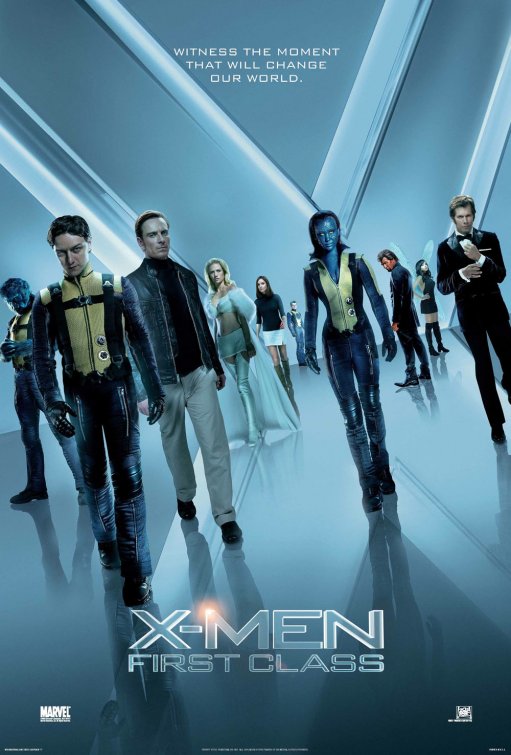
X-Men: First Class Movie Poster

Thursday, 15 December 2011

The Descendants

*****
A warm aloha to Alexander Payne as he returns after a seven year hiatus from writing and directing features. Payne goes from strength to strength with this Hawaiian-set story. George Clooney, also enjoying a purple patch, is proving himself to be a peculiar anomaly: an A-lister whose name on the credits ensures a stamp of quality.

Matt King (Clooney) and his family are descendants of white missionaries and Hawaiian royalty. King is the sole trustee of some prime real estate on the Hawaiian island of Kaua'i left to his family by their ancestors. He and his relatives look to get enormously rich from the morally dubious sale of the land. However, the main focus of the tale is on King’s struggle to keep his family from falling apart. He has troubles with his two daughters. He also has marital problems but here’s the kicker: his wife is in a coma following a boating accident. As the tragedy unfolds the legacy of King’s forefathers (i.e. the land) gains more significance.

It doesn’t sound like the most fun but if you’re familiar with any of Payne’s previous work you won’t be surprised that it is. The action unfolds with a good deal of humour. If you haven’t seen his previous works, Election, About Schmidt, or Sideways, then I can’t recommend them enough. As with all of the above, Payne supplies large doses of both hilarity and seriousness. But it is with his latest film that he delivers a little more of the latter. Something truly profound is achieved amidst the comedy. It poses (and answers) some serious questions about family, loyalty, life, and love. Peculiarly in this his most poignant work Payne’s new co-writers Nat Faxon and Jim Rash possess comic credentials of the decidedly lower brow variety. (An important lesson here: never judge a writer by their IMDb profile.)

Clooney lobbied for the Thomas Haden Church role in Sideways but Payne, wanting someone less well known, turned him down. Their cinematic union on this has proved much more effective (I’m sure) and was certainly worth the wait. And even the smallest of roles has real potency. Beau Bridges, Robert Forster, Matthew Lillard, Judy Greer all impress in the film. The entire project drips with quality.


Thursday, 10 November 2011

Normal Service Will Be Resumed Sometime in December

Have badly broken my collar bone and will be taking a break from blogging.
I will hopefully not be embarking on escapades similar to those of Jimmy Stewart in Rear Window or James Caan in Misery but simply watching an awful lot of DVDs... 
In the meantime, the site is still "live" and all older reviews still available for your perusal.
Best regards,
William "Filmchild" Goodchild

Sunday, 30 October 2011

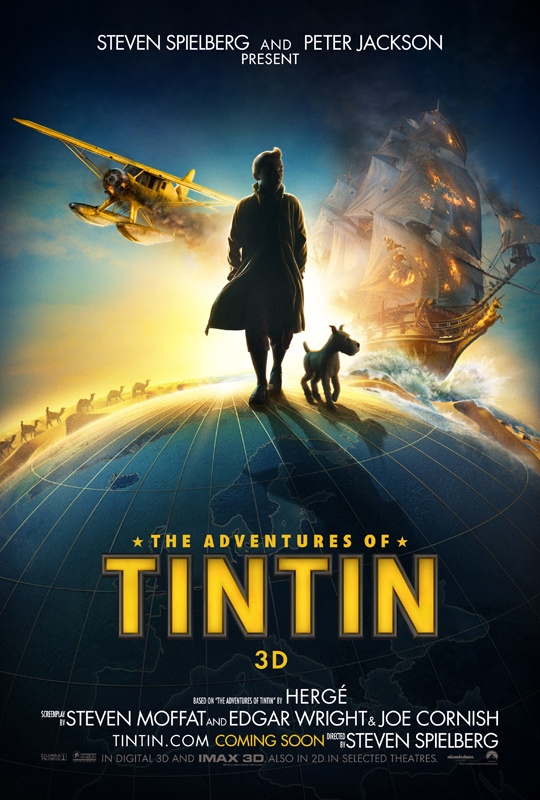
The Adventures of Tintin: The Secret of the Unicorn

**
More pointless motion capture and, depressingly, from Steven Spielberg. This approach is neither photo-real nor commits fully to being overtly stylised. The resulting look is a charmless halfway-house that beggars the question, why? Live action could have delivered spectacle and a real sense of drama, straight animation could have supplied the magic of the books which this is distinctly lacking.

Young reporter Tintin (Jamie Bell) and his dog Snowy embark on an adventure with Captain Haddock (Andy Serkis). Ivanovich Sakharine (Daniel Craig) is the baddie on their tail. The skills of Simon Pegg and Nick Frost (Thompson & Thomson) are also ineffectually utilised.

The motion capture technology has a long way to come. As with previous mo-cap efforts, any dialogue spoken doesn’t sit well with the digital character models. The words feel detached, creating an odd, robotic feel. See The Polar Express and Beowulf for other examples. (Or rather, please don’t.) On the subject of dialogue, it’s striking how poor the entire cast are as voice artists. Daniel Craig’s attempt at cut glass brings to mind Ewan Macgregor’s cringey Obi-Wan. And Jamie Bell, not exactly renowned for his vocal ability, makes for a pathetic Tintin.

Edgar Wright and Joe Cornish have delivered a haplessly weak script along with Doctor Who writer-in-chief Stephen Moffat. Script-wise it’s easy to spot the similarities between this and Doctor Who, with its crappy, bland humour. The jokes – poor in the first place - fall flat throughout the entire film. And it’s not entirely the writers’ fault - Spielberg seems to have lost all sense of his famous precision timing. However, it's all very pretty and some of the action is impressive but all very unnecessarily close-up. Wide shots seem to occur only to establish scenes. Along with the extraneous 3D it all makes for a vomit-tastic experience.

Unlike the likes of Raiders of the Lost Ark and ET – to be enjoyed by those of all ages – this is very much a children’s film. Unless you’re taking your kids, avoid.


Saturday, 29 October 2011

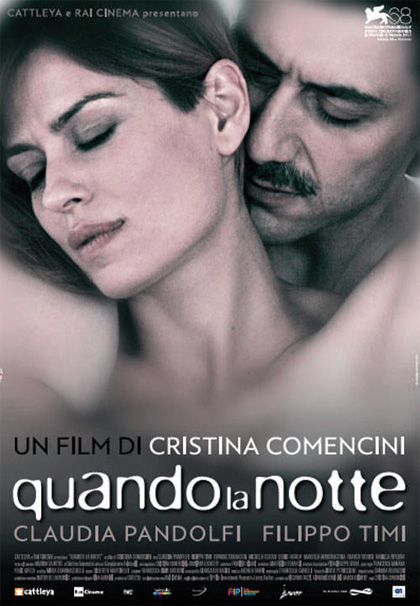
Quando la Notte (When the Night)

***
When the Night is directed by Cristina Comencini and adapted from her own novel.

Marina (Claudia Pandolfi) takes her problematic two year-old son to the mountains for a sabbatical. Her toddler doesn’t sleep and he does not stop crying. This drives the poor woman, understandably, a bit loopy. (The incessant wailing drove me a bit loopy.) All the while, strange tensions develop between her and the standoffish landlord (Filippo Timi) as they co-habit in a remote alpine cabin.  

This is not a barrel of laughs, no. It’s intense, heady stuff. While I’m told that parenthood, even in the toughest of times still supplies occasional glimmers of joy, this has none of that. It purely focuses on the downside.

The narrative is somewhat uneven. It lacks a clear story arc. The ending feels rushed, a bit tagged-on, which I find is common with book adaptations. So often there’s just too much information to squeeze in to a couple of hours. But the film does have a lot of passion. The locations are spectacular and not always in a “chocolate box” kind of way. In her LFF Q&A, Comencini explained that she wanted a mountain that was “hard-looking”, as opposed to pretty. Against this backdrop, the director has created a peculiar and disturbing atmosphere.

When the Night suggests that a natural instinct for motherhood is not always a given. This is a bold and brave statement to make and one that ought to be welcomed. Since 1950, the world’s population has exploded from 2.5 billion to 7 billion and, disturbingly, shows no signs of slowing down. Bearing these facts in mind, it’s refreshing to see a point of view that doesn’t encourage us to breed.


Friday, 28 October 2011

The Ides of March

**** 
This is glossy, conventional film-making and there’s nothing wrong with that. The Ides of March is a smart, political thriller that never condescends. The film’s “polish” simply delivers a serious film in an attractive package.

Stephen Meyers (Ryan Gosling) is the junior campaign manager for the democratic presidential candidate, Mike Morris (George Clooney). Ahead in the polls, things are looking very good for Morris. Meyers is a damn fine operator, seemingly capable of adjusting the alignment of the planets to get Morris elected. He is also an idealist but unfortunately that part doesn’t last. It’s not long before a series of events embroils him in dirty political tricks.

As well as being in the film Clooney, impressively, takes writing, directing and producing credits. While his character looms large, it’s really man-of-the-moment, Gosling’s film – at least on screen. However, Gorgeous George’s self-casting is spot on. He is well-suited to playing the “The Next President of the United States” – honest and direct, likeable and unflappable - all these qualities at least indicated by his public persona. (I’d certainly vote for him.) Philip Seymour Hoffman plays the campaign manager and Paul Giamatti as his opposite backing Morris' competition. These two been-round-the-block characters are played with relish (and unsurprising accomplishment) by two of the best character actors in the world. While their outlooks are very different, I couldn’t help but think how capable they’d each be at playing the other’s role. Young padawan, Evan Rachel Wood beefs up her already-impressive CV, further proving that she is not intimidated by actors of the heavyweight variety. Notable mentions to co-writers Beau Willimon (on whose play the film is based) and the “undiscovered talent” that is Grant Heslov, director of the brilliant and criminally-underrated The Men Who Stare at Goats.

But to get back to Clooney – he’s doing what Hollywood was doing in the seventies - not only is he making his films thought-provoking, he’s making them look good.

Tuesday, 18 October 2011

Alps

***
Director Giorgos Lanthimos collaborates further with co-writer Efthymis Filippou to create something even more leftfield than Dogtooth.

The Alps of the title refers to a clandestine group in which each member is codenamed after an alpine peak. They offer a bizarre service to the bereaved, supplying a surrogate loved one, replacing those who have recently died. The replacement spends periods with the family etc, dressing and behaving like the deceased, speaking in a formerly-agreed script. Nuts? You betcha. The film raises more questions than answers, most notably who is crazier – the people who do this for a living or the people who hire them?

The shooting style is verité and the acting naturalistic (some of the cast are non-actors). It all makes for a raw and realistic package. I feel it’s a little underwritten. It’s not clear what some of the scenes are meant to be telling us and the plot is a little muddled. But Alps is startling in its originality. It’s not often you can say a new film is unique but this one is. As the subject matter would suggest, it’s extremely quirky. It’s funny and uncomfortably so. It doesn’t, however, make light of each situation. The consequences are a powerful reminder that it’s not all just a game.

The film was exec-produced by Athina Rachel Tsangari, writer and director of the recently well-received Attenberg. Not hugely renowned for its cinema, it seems Greece is experiencing a new vibrancy in this area. Let’s hope the current austerity measures don’t put an end to that.